Travel eSIM or roaming on your next trip out of Nigeria
Travel eSIM or roaming from Nigeria? How each one bills you, how to keep your Nigerian line on for bank OTPs, and when a local SIM is the better buy.
5 min read
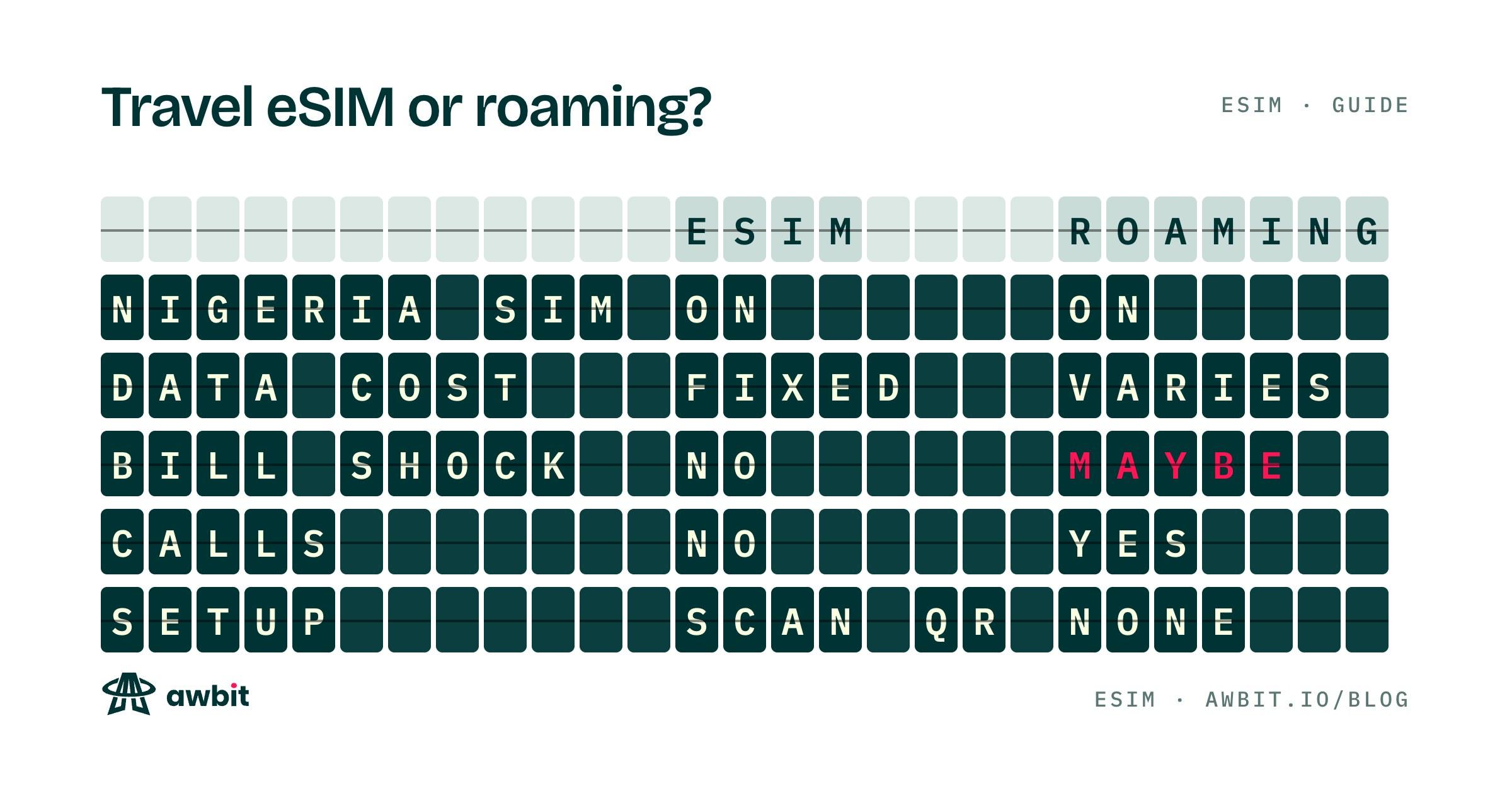
Your bank still sends its OTPs to the Nigerian line you've had for ten years, and in a few days you'll be in an arrival hall in London or Dubai wanting a map and a ride. You can let your Nigerian network carry you abroad on roaming, or you can buy a travel eSIM for the data and leave the Nigerian SIM in the phone for calls and texts. The two charge you in completely different ways.
Your network keeps billing you abroad
On roaming, a foreign network carries your calls and data and sends the bill to your Nigerian network, which passes it on to you. The rate depends on the country you're in and on whether you bought a roaming bundle before you left. Without a bundle you pay as you go. On a prepaid line the charges come off your airtime as you use it. On a postpaid line they turn up on the bill after you're home, when there's nothing left to change.
On a lot of roaming tariffs you pay to receive a call as well as to make one. Airtel has run promotions that make incoming calls free while roaming, which tells you what the normal tariff does.
Background data
Data is the expensive part, because the phone spends it without asking you. Photo backup starts the moment you walk out of the hotel Wi-Fi. WhatsApp downloads every video in the family group. On pay-as-you-go roaming each megabyte of that is billed at the roaming rate, and a prepaid line can run its airtime down to zero before you look at it.
A roaming bundle caps the damage, as long as you know what happens when it finishes. On many tariffs the line drops back to pay-as-you-go rates once the bundle is used up. Ask your network what yours does before you fly.
Prepaid data for a set number of days
A travel eSIM is a data plan you download onto the phone in place of a plastic SIM. You pick a destination or a region and a data size, pay once, and get a fixed amount of data that lasts a fixed number of days. There is no per-megabyte rate to look up and nothing billed after the trip.
On Awbit the full price shows before you buy, and it comes out of your naira wallet. Your bank card never meets a foreign checkout. On most plans the clock starts when the eSIM first connects at your destination, not when you pay, and each plan's page states its exact validity rules. Regional plans cover a whole Europe or Gulf trip on one QR code. If you run low halfway through, you buy another plan from your dashboard.
These are data plans, with no local number for anyone to ring. A few of them block hotspot, and those say so before you buy. Your phone also has to support eSIM and must not be locked to a carrier. A locked phone can't take the eSIM at all.
Keep the Nigerian line on for OTPs
Most phones that take an eSIM run two lines at once, the physical SIM and the eSIM. Set them up so the eSIM carries the data and the Nigerian SIM stays on for calls and SMS:
- Choose the eSIM as the mobile data line.
- Turn data roaming on for the eSIM line and off for the Nigerian line.
- Leave the Nigerian line switched on.
- On iPhone, turn off Allow Cellular Data Switching. With it on, the phone can fall back to the Nigerian line for data whenever the eSIM signal dips, and if roaming data is allowed on that line, you pay roaming rates for it.
WhatsApp keeps working on your Nigerian number, because WhatsApp only needs a data connection and doesn't care which SIM provides it.
The eSIM can't help the Nigerian SIM receive anything, though. That SIM only gets your bank's texts if it can register on a network at your destination, which needs international roaming switched on for your line. Before you fly, ask your network whether roaming is active on your line and what it charges you to receive an SMS abroad. If the answer to the first question is no, the OTPs stop at the border whatever eSIM you buy.
When you need a number people can call
Some trips are mostly phone calls. Clients ring your Nigerian number about invoices, or your mother won't use WhatsApp and calls the line she knows. An eSIM from Awbit does nothing for either of those. A roaming bundle from your own network that includes calls does. If the trip is four days of calls and a little email, buy the roaming bundle and skip the eSIM.
If you need a number that people inside the country you're visiting can call, that's a local SIM bought after you land.
Staying longer than a month
For a move abroad or a long course of study, the eSIM is a first-week tool. It gives you maps and your banking app while you house-hunt. After that you want a local number for the landlord and for the bank account you're about to open, on a monthly plan priced for people who live there. In many countries you need your passport to register a SIM. Land with the eSIM, then buy the local line once you know which network the people around you use.
Don't let the Nigerian line go dead while you're away. Networks reclaim numbers that sit idle for long enough, and your bank and your WhatsApp both hang off that number. Some networks sell a plan that holds your number for a year or more. Ask yours before you leave.
On Awbit
Pick a destination or region and a data size on the eSIM page and pay from your wallet. The QR code shows on your order page, usually inside a minute, with install steps for iPhone and Android and manual-entry details under them for when the QR won't scan. Install it at home on Wi-Fi and switch it on when you land.
Is your phone ready for one?
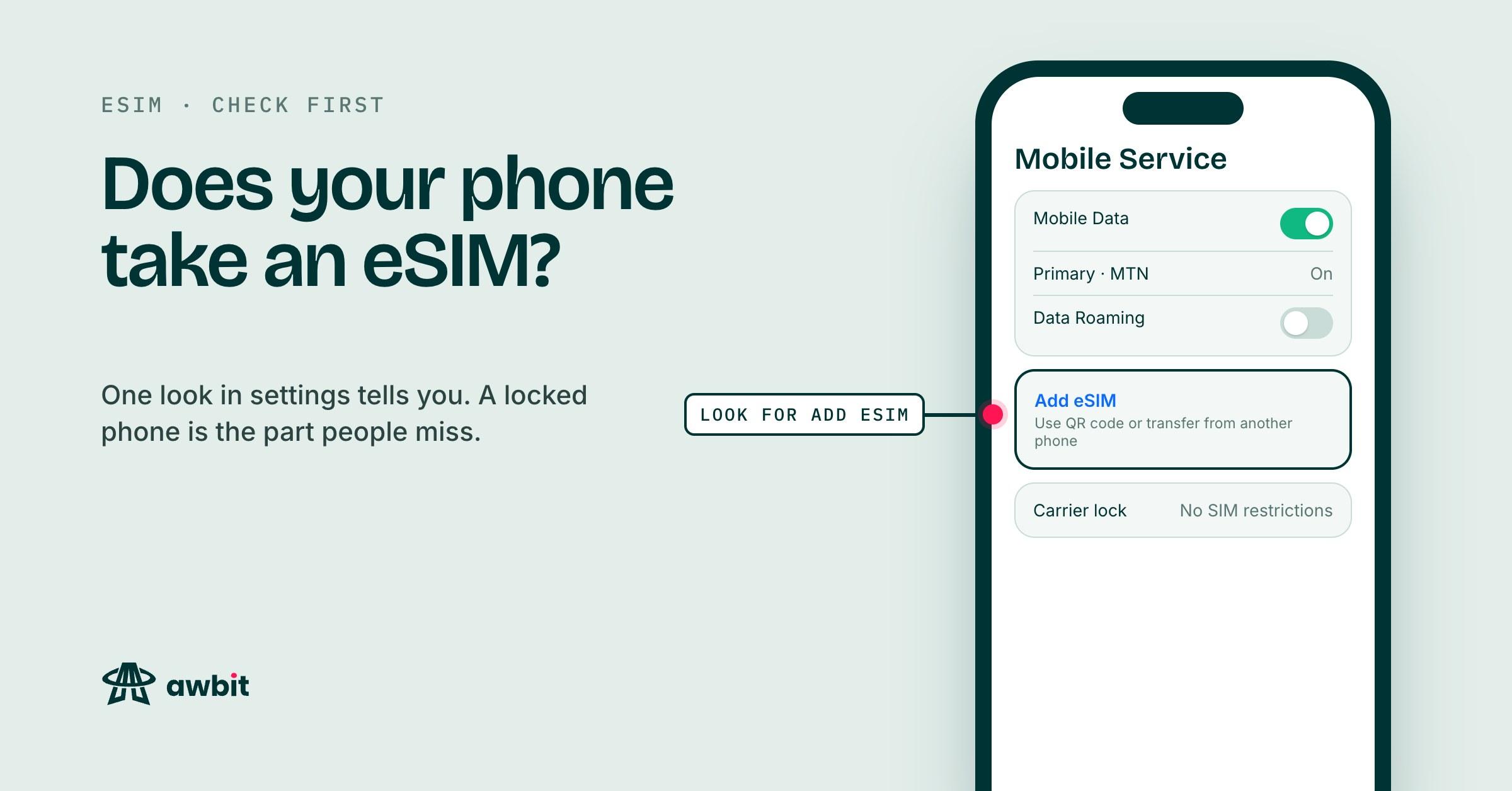
Check before you spend anything. On iPhone, look for Add eSIM under Settings > Cellular, then open Settings > General > About and read the Carrier Lock line. It should say No SIM Restrictions. On Android, look for an Add eSIM option in the SIM settings; on a Samsung that's Settings > Connections > SIM manager. A phone bought on contract abroad is often still locked to the network that sold it, and a locked phone won't take a travel eSIM. If yours fails either check, your choices are roaming or a local SIM bought on arrival.